How to Plan a Climbing Gym:
3 Critical Design Risks to Address Early
Opening or expanding a climbing gym is a spatial, structural, and operational undertaking. Early planning decisions influence construction cost, usable climbing surface, and long-term performance.
Across international projects in Europe, Asia, the Middle East, and North America, certain planning risks consistently emerge. These risks are not the result of poor preparation. They arise because climbing gym design combines architecture, structural engineering, wall systems, and business strategy within a single environment.
Addressing them early reduces financial and operational uncertainty.
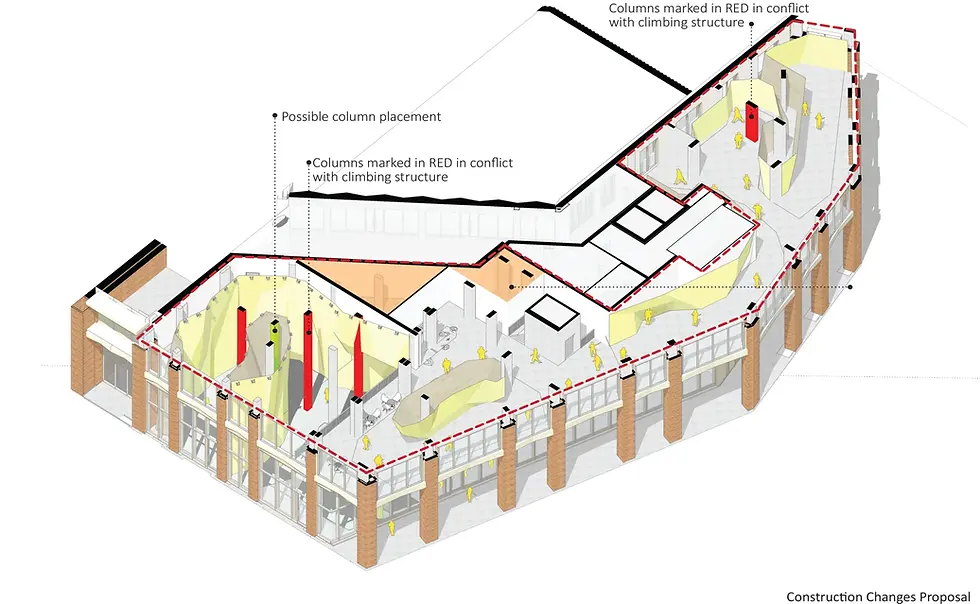
Evaluating a Building Without Climbing-Specific Feasibility Analysis
Commercial real estate evaluation typically focuses on rent, location, and accessibility.
Climbing gym planning requires an additional technical layer.
Key Structural and Spatial Parameters to Assess
-
Clear ceiling height (bouldering: typically 4–4.5 m / 13–15 ft; rope climbing: 12–15 m / 40–50 ft)
-
Structural constraints affecting wall placement
-
Structural load capacity for climbing wall attachment
-
Adequate floor depth to accommodate circulation paths and safety clearances
-
Fire escape strategy, occupant load calculations, and local building code compliance
Common Consequences of Late Structural Evaluation
-
Loss of usable climbing surface due to structural conflicts
-
Compromised wall placement affecting circulation and fall zone clarity
-
Increased structural and fabrication costs from reactive redesign
-
Height or geometry adjustments caused by overlooked beam constraints
-
Extended coordination during construction, impacting timeline and budget
Climbing walls are inherently flexible systems. They can adapt to irregular footprints, unconventional volumes, and non-standard buildings. In many projects, these spatial constraints become design opportunities.
However, flexibility does not eliminate structural logic.
Even when geometry responds creatively to an unusual building, attachment strategy, load transfer, consistent usable height, and the relationship between columns and fall zones must be resolved early.
When these elements are addressed late, design becomes reactive instead of strategic.
In climbing gym architecture, the building does not limit creativity — it defines the framework within which wall geometry performs.
A feasibility study at concept stage protects spatial quality and budget clarity.

Climbing Terrain Breakdown - Triaden Klatresenter
Defining Wall Geometry Without Operational Clarity
Climbing wall geometry must reflect how the facility intends to operate.
Terrain distribution should follow strategic positioning rather than visual preference.
Operational Parameters to Define Before Designing Wall Geometry
-
Target demographic mix
-
Balance between bouldering and rope climbing
-
Role of training and coaching
-
Event or competition ambitions
-
Progression strategy across difficulty levels
Consequences of Misaligned Wall Geometry
-
Imbalanced slab, vertical, and steep terrain
-
Reduced route-setting flexibility
-
Underused or overcrowded zones
-
Limited progression clarity
-
Lower long-term adaptability
Climbing wall design is a long-term infrastructure decision.
Its composition influences retention, resetting efficiency, and spatial performance over time.
When geometry aligns with operational strategy, the gym remains adaptable as user demographics evolve.

Triaden Klatresenter, Norway
Maximizing Climbing Surface Without Protecting Spatial Logic
Increasing climbing square meters is a common objective in climbing gym development. Spatial performance depends on layout intelligence.
Core Spatial Systems in Climbing Gym Layout Design
-
Clear entry sequence and reception visibility
-
Intuitive circulation loops
-
Clearly defined fall zones
-
Integration of social and spectator zones
-
Clear staff supervision lines
Consequences of Weak Spatial Logic
-
Congestion during peak hours
-
Compromised fall zone clearances
-
Limited flexibility for events and group sessions
-
Lower operational efficiency
-
Reduced spatial comfort
Climbing gym architecture should create legibility and visual openness.
Well-coordinated circulation supports safety, customer retention, and operational control.
Surface density alone does not define performance. Spatial clarity does.

Boulder. Qatar
Integrated Planning as Risk Management
Climbing gym construction is capital-intensive, and early planning decisions shape far more than the initial layout. They influence structural investment, wall fabrication strategy, construction timelines, route-setting adaptability, and long-term operational performance.
Successful climbing gym projects emerge when architectural layout, structural systems, wall geometry, route-setting logic, and business objectives are aligned from the concept stage. When these elements are coordinated early, the project develops with clarity and control.
Integrated planning is not an added layer of complexity. It is a method of protecting long-term value, reducing redesign, and ensuring that the facility performs as intended years after opening.
Planning a New Climbing Gym or Expansion?
Altline Studio specializes in climbing gym architecture and climbing wall design worldwide — from feasibility studies and space planning to detailed climbing walls design and manufacturer coordination.
If you are planning a new climbing gym or expanding an existing facility, early architectural coordination strengthens design clarity and long-term performance.